
State of AI Agents in 2025
A practical review of AI-agent advances in planning, autonomy, memory, multi-agent coordination, and production operations.
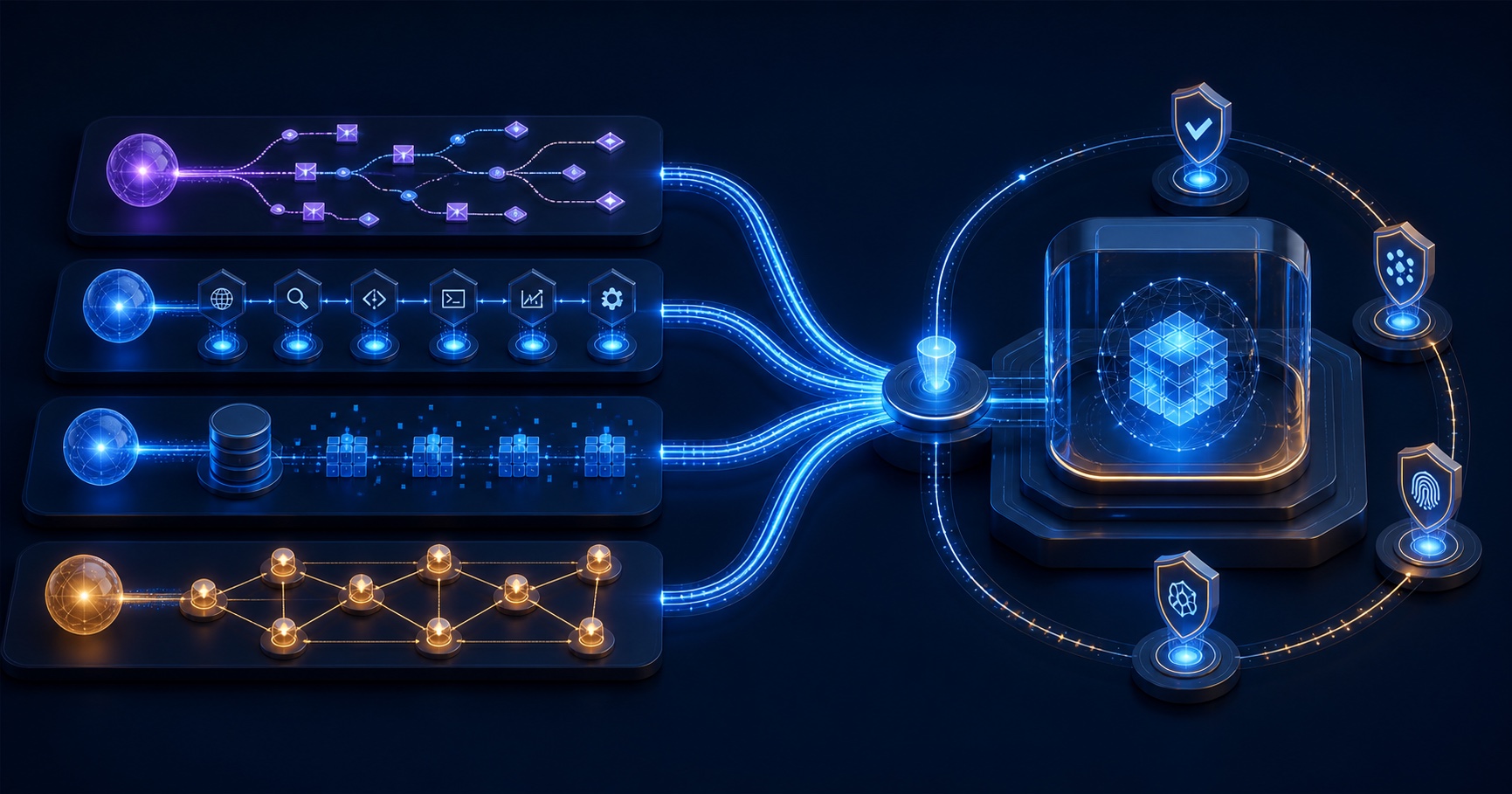
Updated August 2026 to correct terminology, qualify research claims, and reflect the current governance of agent interoperability standards. The article's focus remains the state of the field in 2025.
Introduction
Agentic AI—systems that use models, tools, and control logic to pursue goals through a sequence of decisions and actions—has moved quickly from demos into early enterprise use. Unlike a static chatbot, an agent can plan a multi-step task, call external tools, maintain working context, and coordinate with other agents. Experimental projects from 2023, such as AutoGPT and BabyAGI, helped popularize autonomous task loops. Research methods such as Tree of Thoughts (ToT) explored multiple reasoning paths before selecting an answer, while Reflexion used feedback and episodic text memory to improve later attempts without updating model weights. Open-source frameworks such as AutoGen and LangGraph made it easier to implement stateful, tool-using workflows, although the framework alone does not make an agent reliable.
This article breaks down the advances that shaped the field in 2025—planning, autonomy, memory, multi-agent collaboration, and production operations—and examines both their value and their limitations.
Planning and Decision-Making
LLMs often produce shallow or flawed plans. Chain-of-thought (CoT) prompting can elicit intermediate reasoning steps, while Tree of Thoughts (ToT) explicitly explores and evaluates multiple candidate paths. These methods can help on some tasks, but neither guarantees a sound plan.
ReAct provides the bridge between planning and execution. It interleaves model-generated reasoning steps with actions and observations, allowing an agent to gather external information, track progress, and revise its next step. The pattern improved results on the question-answering and interactive environments evaluated in the original study, but it does not guarantee reliable behavior: an agent can still choose the wrong tool, misinterpret an observation, or become trapped in a loop.
Planning techniques need an execution layer that turns a proposed sequence into controllable steps. LangGraph represents workflows as stateful graphs and persists checkpoints for revision or recovery; AutoGen coordinates agents through team conversation patterns and explicit termination conditions; and Semantic Kernel provides sequential, concurrent, and handoff orchestration patterns. These frameworks make plans explicit, executable, and easier to inspect, but they do not make the underlying model a better planner. Semantic Kernel’s agent-orchestration APIs were still experimental at the time of this review.
Strengths and Limitations: Structured reasoning can make a process easier to inspect and can improve results on suitable tasks. The gains are task- and model-dependent, however; plausible intermediate steps can still support a wrong answer. Exploring and evaluating multiple branches also increases latency and model cost, while production planning workflows require careful state design, termination conditions, and tests.
Autonomy and Self-Governance
Autonomous agents can pursue multi-step goals without human input at every step. For instance, Reflexion stores language-based feedback from one attempt and supplies it as context to a later attempt. This is a form of inference-time adaptation, not durable learning in the model itself.
Frameworks such as AutoGen and CrewAI provide components for delegation, tool use, and multi-agent workflows. They can support tasks such as researching travel options or drafting reports; actions with financial, legal, or operational consequences still need explicit permissions and appropriate human review.
Strengths and Limitations: Autonomy can reduce manual coordination and keep long-running workflows moving. But each additional action expands the failure surface: the agent may choose the wrong tool, act on stale context, repeat an operation, or compound an earlier error. Higher-impact autonomy therefore requires stronger monitoring, access controls, budgets, rollback mechanisms, and escalation paths.
Memory and Long-Term Context
Agents running long workflows can lose track of what they have done and repeat themselves. They need mechanisms to recall prior steps, preserve relevant context, and resume work without replaying the entire history.
Memory modules externalize information that the model can retrieve later: conversation history, workflow checkpoints, user preferences, summaries, or records of previous actions. Vector databases such as Faiss, Qdrant, and Milvus support similarity-based retrieval, but they are only one option; relational stores, document indexes, event logs, and knowledge graphs may be better when recency, structure, or exact lookup matters. Approaches such as memory streams and reflective loops help agents revisit selected observations rather than sending an ever-growing transcript on every turn.
Both focused memory systems and general agent frameworks now offer memory components. Examples include Mem0, LangGraph, AutoGen, and Haystack.
Strengths and Limitations: Memory can improve continuity, personalization, and efficiency. But deciding what to store, retrieve, update, or delete remains difficult. Retrieved memories can be stale, irrelevant, contradictory, sensitive, or even maliciously injected. A model also has no persistent internal state between calls unless the application supplies it, so memory quality depends on the surrounding storage, retrieval, and governance design.
For a production design that treats memory as governed retrieval rather than a vector-store feature, see Agent Memory Is a Search System.
Multi-Agent Collaboration and Coordination
Multi-agent systems divide a workflow among specialized components that can delegate, critique, or run work in parallel. This can help when tasks have clear separations of responsibility, but it also introduces coordination overhead that a single well-designed agent may avoid. Several research lines shaped this area:
- Multi-Agent Reinforcement Learning (MARL): Deep Coordination Graphs factor a team's joint value function into pairwise payoffs and use message passing to select coordinated actions. This improves efficiency in the tested predator-prey and StarCraft II micromanagement environments; it is not a general mechanism for dynamically assigning enterprise roles.
- CICERO: Meta's system combined a controllable dialogue model with strategic reasoning and achieved human-level performance in the game Diplomacy. The result is important but scoped: it demonstrates negotiation and cooperation in a specific game with explicit rules and measurable objectives.
- LLM-based coordination: In the LLM-Coordination benchmark, GPT-4-turbo-based agents were comparable to strong reinforcement-learning methods in several commonsense coordination games and more robust to unseen partners. The same study found substantial room for improvement in theory-of-mind reasoning and joint planning, so the result should not be generalized to all multi-agent settings.
- Emergent behavior: OpenAI's hide-and-seek research showed reinforcement-learning agents discovering increasingly complex strategies and tool use in a simulated environment. Stanford's Generative Agents showed believable social behaviors emerging from memory, reflection, and planning. These controlled demonstrations reveal possibilities, not evidence that unconstrained agent collectives will reliably organize themselves in production.
Frameworks such as AutoGen, CrewAI, MetaGPT, and LangGraph provide different abstractions for building and orchestrating multi-agent workflows. Interoperability standards address a separate layer: the Model Context Protocol (MCP) connects AI applications to tools and data, while the Agent2Agent Protocol (A2A) supports communication between agents. A2A moved to Linux Foundation governance in July 2025, and MCP became a Linux Foundation Agentic AI Foundation project in December 2025.
Strengths and Limitations: Parallelism and specialization can improve throughput and make responsibilities explicit. They can also multiply model calls, swamp communication channels, duplicate work, and propagate a bad decision across the team. Reliable multi-agent systems need bounded roles, shared-state rules, conflict resolution, time and cost budgets, and clear failure handling. MCP and A2A reduce integration friction, but protocol compatibility does not by itself provide correctness, security, or trust between participants.
The architecture decision and its measurement criteria are developed in The Coordination Tax: When Multi-Agent Systems Are Worth It.
Operationalizing Agentic AI: AgentOps and Reliability
AI agents are nondeterministic and interact with changing external systems, so monitoring and control are essential. This has led to the rise of AgentOps, which applies DevOps and MLOps practices to the agent lifecycle. In practice, the discipline spans observability, evaluation, governance, and continuous improvement.
AgentOps tools instrument and monitor agent runs. Platforms such as AgentOps.ai can capture model calls, tool usage, timings, token consumption, and errors. This supports execution tracing, step-by-step debugging, cost tracking, and evaluation. Microsoft Foundry similarly provides OpenTelemetry-based tracing for inputs, outputs, tool calls, retries, latency, and costs. These traces expose the application's execution path; they should not be described as a faithful record of a model's hidden reasoning.
Research foundations: AgentOps is primarily an engineering discipline, informed by software observability, LLM evaluation, human-in-the-loop system design, and AI risk management. Frameworks such as the NIST AI Risk Management Framework reinforce the need to govern, map, measure, and manage risk across the system lifecycle. Production feedback can inform new tests, prompts, policies, or training data, but automatically learning from live traffic is a separate and higher-risk design choice.
Practical strengths: AgentOps makes production behavior more observable and can speed debugging by showing where a run failed or became expensive. Trace data can support audits when instrumentation coverage, retention, and access controls are designed appropriately. Runtime controls can restrict tools, require approval for sensitive actions, and stop loops that exceed time or cost budgets. These controls come from the complete application architecture, not from observability alone.
The evaluation side of this operating discipline is developed in Towards Reliable AI Agents.
Current limitations: Agent observability remains an evolving area, and traces still require expert interpretation. Instrumentation can be incomplete, sampled, or inconsistent across frameworks. Observability detects symptoms but does not inherently fix logic errors or prove that an output is correct. Traces may also contain prompts, tool arguments, model outputs, credentials, or personal data, so minimization, redaction, access control, and retention policies are essential. Despite these limitations, agent monitoring is becoming as important as application monitoring is for traditional software.
Core Capabilities for Enterprise Adoption
The practical adoption of AI agents in the enterprise depends on four key capabilities. While interconnected, each addresses a distinct set of business challenges, moving AI from a passive assistant to an active participant in workflows.
1. Autonomy and Orchestration This is the most direct value driver. Instead of only responding to queries, agents can execute multi-step workflows across systems based on natural-language instructions. This can reduce manual steps in tasks such as data analysis, API orchestration, and content generation, although it also introduces new classes of error. Autonomy should expand according to demonstrated reliability and the impact of failure, moving from contained, reversible tasks toward higher-risk processes only when controls justify it.
2. Memory and Context Integration Memory and context integration can turn a generic model into a system grounded in business data, user interactions, and previous actions. Some form of state is necessary for workflows that span multiple steps or sessions. But memory does not ensure accuracy, rule-following, or learning: stored information must be authorized, current, relevant, and retrieved at the right time.
3. Advanced Planning and Reasoning For complex or high-stakes tasks, planning helps separate a convincing demo from a maintainable system. It allows an agent to break an ambiguous goal into concrete steps, revise a workflow after new information, and identify where approval is required. Better planning can reduce routine supervision, but high-stakes decisions still require validation, domain controls, and escalation rather than an assumption that the agent can navigate them reliably on its own.
4. Multi-Agent Collaboration Multi-agent systems can help when a problem benefits from distinct roles—such as a planner, a coder, and a validator—or from parallel work with independently checkable outputs. Agents may delegate tasks, exchange results, and critique one another. The pattern is not automatically better than a single agent: use it when specialization or concurrency outweighs the added communication, latency, cost, and failure modes.
Conclusion
AI agents have evolved through better planning, tool use, context management, and orchestration. These advances allow them to handle more complex workflows than earlier chat interfaces, but capability remains uneven and strongly dependent on the task, model, tools, and surrounding system design.
At the same time, AgentOps discipline has emerged to ensure these AI systems run reliably and stay under control. Organizations need monitoring, debugging, and governance tools to deploy agents reliably. This operational focus shows that agent technology is transitioning from research labs to production environments.
AI agents are becoming practical tools for automating bounded workflows, analyzing data, and coordinating tasks. Reliable deployment is possible in well-defined settings, but reliability is a property of the complete system—not of the model or framework alone. Success depends on matching agent capabilities and controls to a real business problem rather than chasing the latest research trend.
References
Huang et al., “Understanding the planning of LLM agents: A survey,” arXiv preprint (Feb 2024). [Paper]
Wei et al., “Chain-of-Thought Prompting Elicits Reasoning in Large Language Models,” NeurIPS (2022). [Paper]
Yao et al., “Tree of Thoughts: Deliberate Problem Solving with Large Language Models,” NeurIPS (2023). [Paper]
Yao et al., “ReAct: Synergizing Reasoning and Acting in Language Models,” ICLR (2023). [Paper]
Shinn et al., “Reflexion: Language Agents with Verbal Reinforcement Learning,” NeurIPS (2023). [Paper]
Park et al., “Generative Agents: Interactive Simulacra of Human Behavior,” ACM UIST (2023). [Paper]
Böhmer et al., “Deep Coordination Graphs,” ICML (2020). [Paper]
Bakhtin et al., “Human-level play in the game of Diplomacy by combining language models with strategic reasoning,” Science (2022). [Paper]
Agashe et al., “LLM-Coordination: Evaluating and Analyzing Multi-agent Coordination Abilities in Large Language Models,” Findings of NAACL (2025). [Paper]
Baker et al., “Emergent Tool Use From Multi-Agent Autocurricula,” ICLR (2020). [OpenAI overview]
LangChain, “LangGraph overview,” documentation. [Documentation]
Microsoft, “Teams,” AutoGen documentation. [Documentation]
Microsoft, “Semantic Kernel Agent Orchestration,” documentation. [Documentation]
Google, “Announcing the Agent2Agent Protocol (A2A),” Google Developers Blog (Apr 2025). [Announcement]
Anthropic, “Donating the Model Context Protocol and establishing the Agentic AI Foundation,” (Dec 2025). [Announcement]
AgentOps, “Introduction,” product documentation. [Documentation]
Microsoft, “Agent tracing overview,” Microsoft Foundry documentation. [Documentation]
NIST, Artificial Intelligence Risk Management Framework (AI RMF 1.0) (Jan 2023). [Framework]